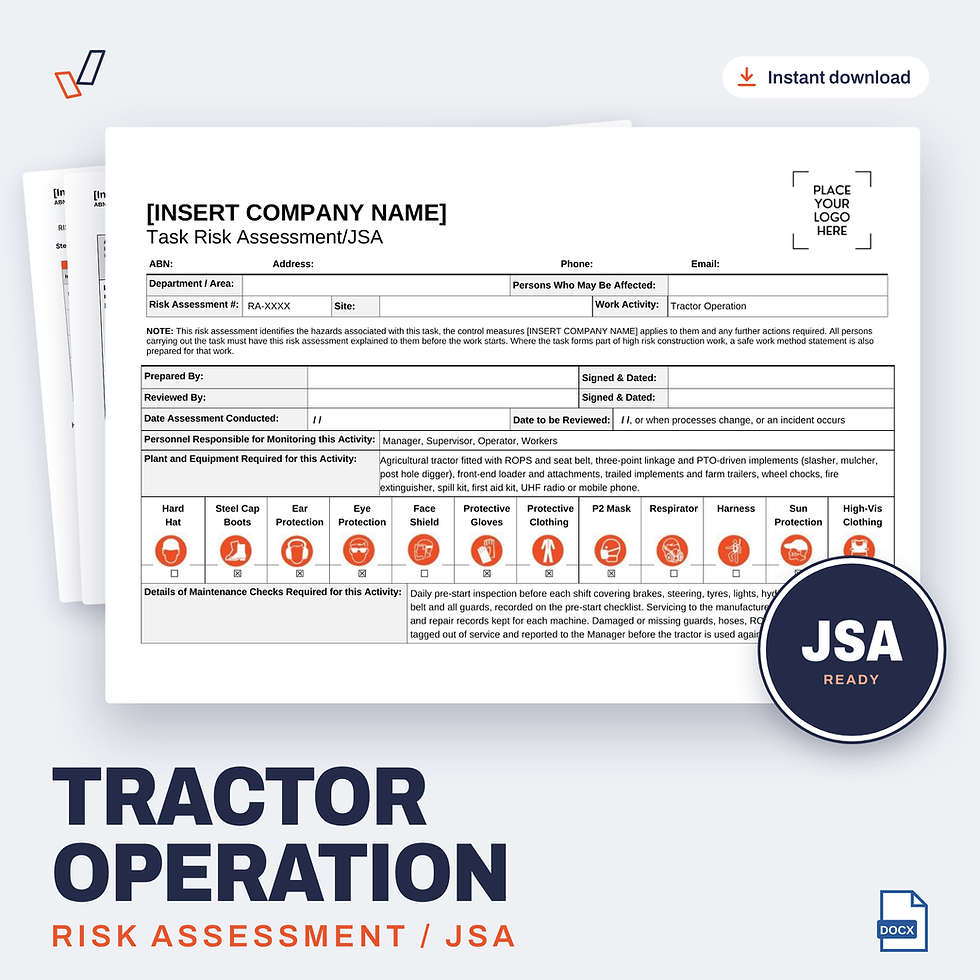
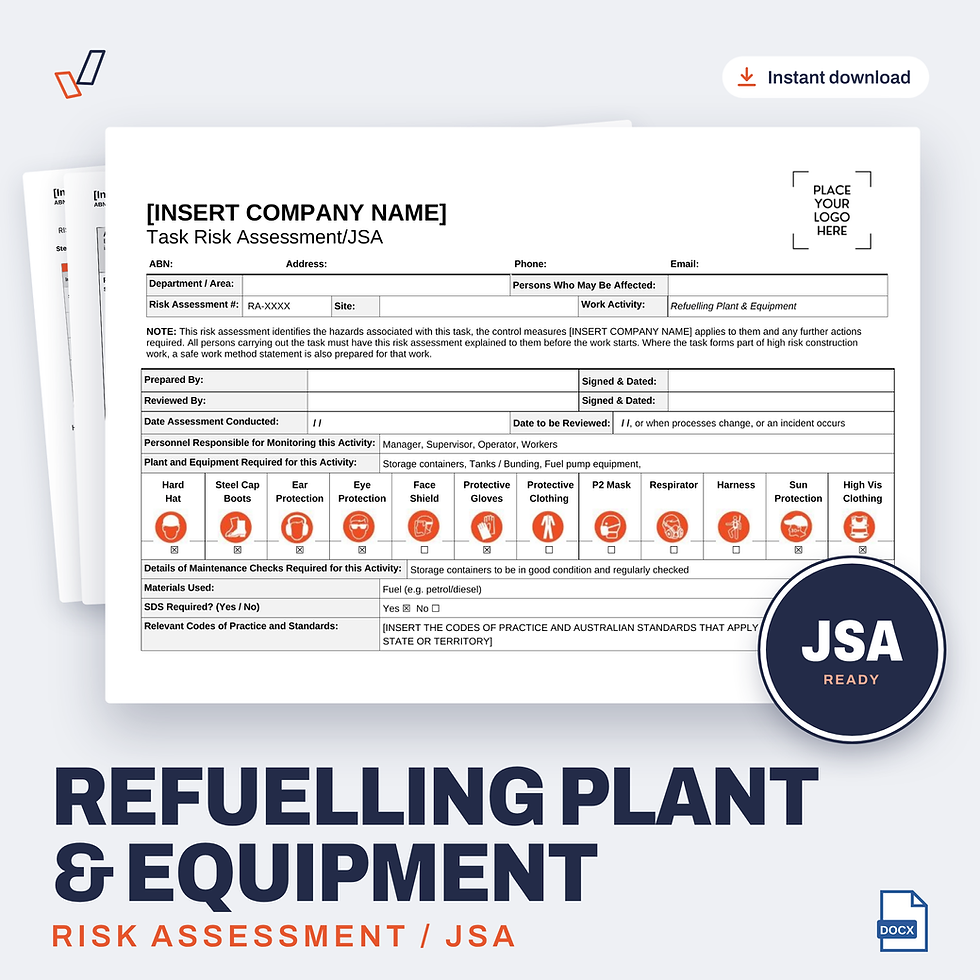
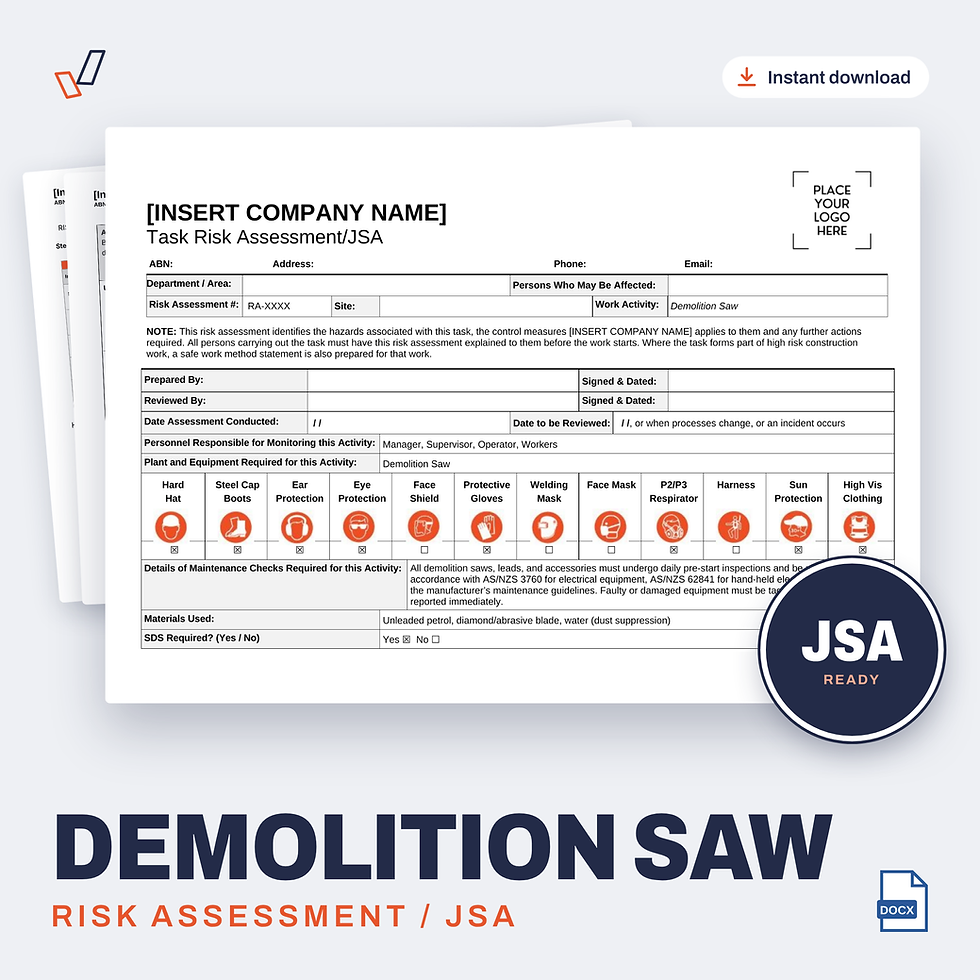
This Excavator Risk Assessment/JSA (Job Safety Analysis) is pre-filled and covers mobilising, setting up and operating an excavator for clearing, trenching and backfilling. It covers 23 activities, from the daily pre-start meeting to emergency response, with the hazards, control measures and risk ratings before and after controls for each. It's written by WHS specialists, aligned to Australian WHS legislation, and fully editable in Microsoft Word.
Who it's for
Excavation and earthmoving contractors
Civil and plumbing contractors digging trenches
Landscapers and site preparation businesses
Plant hire companies supplying operated excavators
Farmers and land clearing contractors
It also works as a written task risk assessment for any business where workers operate an excavator, the same way you'd use a JSA or Safe Work Procedure.
A risk assessment, also called a JSA, JSEA or task risk assessment, records the hazards of a task and how you control them. If the task is part of high risk construction work, the law requires a SWMS for that work, so use our Excavator SWMS instead.
Use it to
Show clients, insurers and auditors how you manage the risks
Apply for tenders, contracts and supplier panels
Get through prequalification with Avetta, Cm3 and other contractor portals
Induct new workers and train them in the task
What this risk assessment covers
Daily pre-start meeting, planning and PPE
Site preparation, ground conditions and underground power
New plant on site, low loader transport and securing the excavator in transit
Pre-operation checks, including overhead powerlines and faulty equipment
Moving and setting up the excavator, including rollover and collisions with people or plant
Tree clearing and pushing felled trees, including falling branches
Marking out, shoring delivery and digging trenches, including cave-ins and nearby structures
Removing shoring and backfilling the trench
Fitting and changing attachments, including quick hitch failure and crush injuries
Refuelling, maintenance, spills and waste handling
Post-work shutdown, out of service controls, remote work and weather
Emergency response to electrical contact, fire, rollover or injury
What's included
Hazards and control measures for 23 work activities
Risk ratings before and after controls, with a 5x5 risk matrix and the hierarchy of controls
PPE requirements checklist
Daily pre-start checks, hydraulic hose maintenance and rules for lifting freely suspended loads
Licence and training requirements, with operator competencies sighted before work starts
Site specific hazards section for anything unique to your job
Further controls action plan to track anything still to be done
Worker sign-off sheet and worker consultation record
Why use this template
Saves hours compared with writing a risk assessment from a blank page
Covers the most common hazards and control measures for this work, ready to use out of the box
Fully editable, so you can add, remove or change anything to suit your workplace and how your team works
Helps your business stay compliant, with risk ratings, an action plan, worker sign-off and consultation records already set up
Comes with a step-by-step implementation guide
How it works
Buy online and download straight away. You'll also get an email with your link.
Add your logo, ABN, area and site details.
Check it suits your workplace and task, edit anything you need to, and consult your workers before you finalise it.
Brief your team and collect signatures.
Common questions
Do I need a SWMS or a risk assessment for excavator work?
A SWMS is legally required when the work is high risk construction work, for example digging a trench deeper than 1.5 metres, working near overhead powerlines, or where other powered mobile plant is moving. Outside those situations it isn't mandatory, but you still have to manage the risks, and a risk assessment or JSA is a practical way to record how. Head contractors and prequalification portals often ask for one either way. If the job is high risk construction work, use our Excavator SWMS instead.
Does it cover quick hitches?
Yes. Fitting and changing attachments is its own activity, covering a bucket or attachment released by a quick hitch that isn't locked, is worn or is incorrectly fitted, and crush injuries during a change.
Can I change it?
Yes. It's a Microsoft Word file, so you can add, remove or change any hazard, control or rating, and add your own logo and details.
Does it suit my state?
Yes. It's written to the model WHS laws and suits all states and territories, including Victoria under the OHS Act and Regulations.
What if it doesn't suit my work?
You're covered by our 30-day money-back guarantee if it isn't fit for purpose.