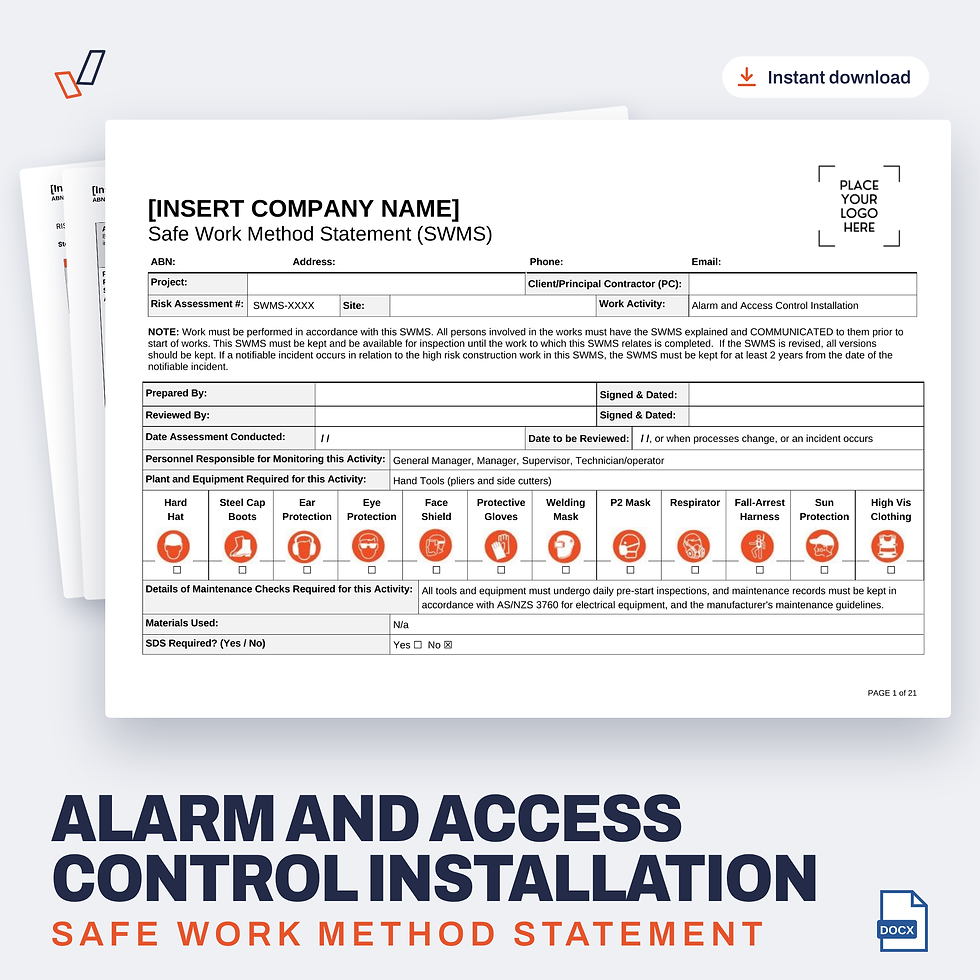
This Battery Energy Storage System (BESS) Installation SWMS (Safe Work Method Statement) is pre-filled and covers installing battery systems, from location assessment and isolation to DC cabling, commissioning and handover. It sets out the hazards, control measures and risk ratings before and after controls for 35 activities, from the daily pre-start to shutdown, demobilisation and emergency response. It's written by WHS specialists, aligned to Australian WHS legislation, and fully editable in Microsoft Word.
Who it's for
Solar and battery installation businesses
Licensed electrical contractors and electricians
Accredited battery system designers and installers
Energy contractors installing walk-in or containerised battery systems
Use it to
Hand clients and principal contractors the SWMS they ask for
Apply for tenders and new jobs with your safety paperwork ready
Get through prequalification with Avetta, Cm3 and other contractor portals
Induct new workers and run toolbox talks on the task
What this SWMS covers
Location assessment against AS/NZS 5139, and hazardous material checks before drilling or entering cavities
Handling heavy battery modules, damage that can lead to thermal runaway, and placement with mobile plant
Roof, ladder and EWP access, and dropped tools striking people below
Isolation and lock-out, backup sub-boards and island-mode changeover
PV array isolation, and stranded energy in terminals, busbars and inverter capacitors
Work at or near the live switchboard, with arc flash and electrocution controls
Mounting the enclosure, concealed services, and silica dust from drilling masonry and fibre cement
Fire barriers, clearances, ventilation and cooling for the battery
DC cabling, battery interconnection, and AC connection to the switchboard and inverter
Walk-in battery containers, ceiling spaces, subfloors and plant rooms
Energisation, commissioning, testing, and removal of existing or failed batteries
Thermal runaway response, labelling and handover, and emergency response to shock, arc flash or a fall
What's included
Hazards and control measures for 35 work activities
Risk ratings before and after controls, with a 5x5 risk matrix and the hierarchy of controls
PPE requirements checklist and high risk construction work checklist
Plant and equipment list, materials, and maintenance checks for test instruments, harnesses and battery modules
Relevant Australian Standards, including AS/NZS 5139 for battery systems and AS/NZS 4777.1 for inverter grid connection
Training notes covering the manufacturer's shutdown sequence, thermal runaway response and low voltage rescue
Site specific hazards section for anything unique to your job
Worker sign-off sheet and worker consultation record
Why use this template
Saves hours compared with writing a SWMS from a blank page
Covers the most common hazards and control measures for this work, ready to use out of the box
Fully editable, so you can add, remove or change anything to suit your site and how your team works
Helps your business stay compliant, with risk ratings, worker sign-off and consultation records already set up
How it works
Buy online and download straight away. You'll also get an email with your link.
Add your logo, ABN, project and site details.
Check it suits your site and task, edit anything you need to, and consult your workers before you finalise it.
Brief your team and collect signatures.
Common questions
Do I need a SWMS for battery installation?
A SWMS is legally required when the job is high risk construction work, and battery installs often involve it, for example work on or near energised electrical installations, or roof work where someone could fall more than 2 metres. Outside those situations a SWMS isn't mandatory, but you still have to manage the risks, and a SWMS is a sound way to record how. Clients, head contractors and prequalification portals often ask for one either way.
Does it cover thermal runaway?
Yes. It covers storage and handling that can damage cells, ventilation and cooling, responding to a venting battery or thermal runaway, and training workers to evacuate rather than try to put out a venting battery.
Can I change it?
Yes. It's a Microsoft Word file, so you can add, remove or change any hazard, control or rating, and add your own logo and details.
Does it suit my state?
Yes. It's written to the model WHS laws and suits all states and territories, including Victoria under the OHS Act and Regulations.
What if it doesn't suit my work?
You're covered by our 30-day money-back guarantee if it isn't fit for purpose.