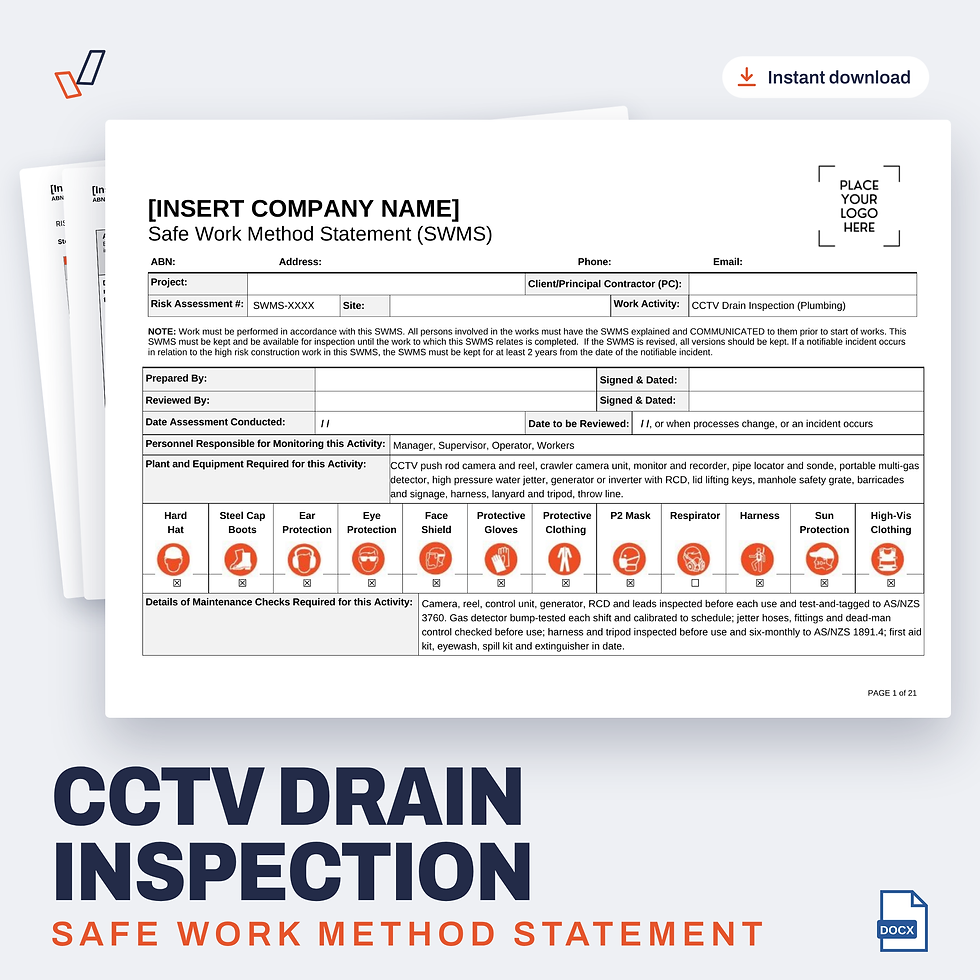
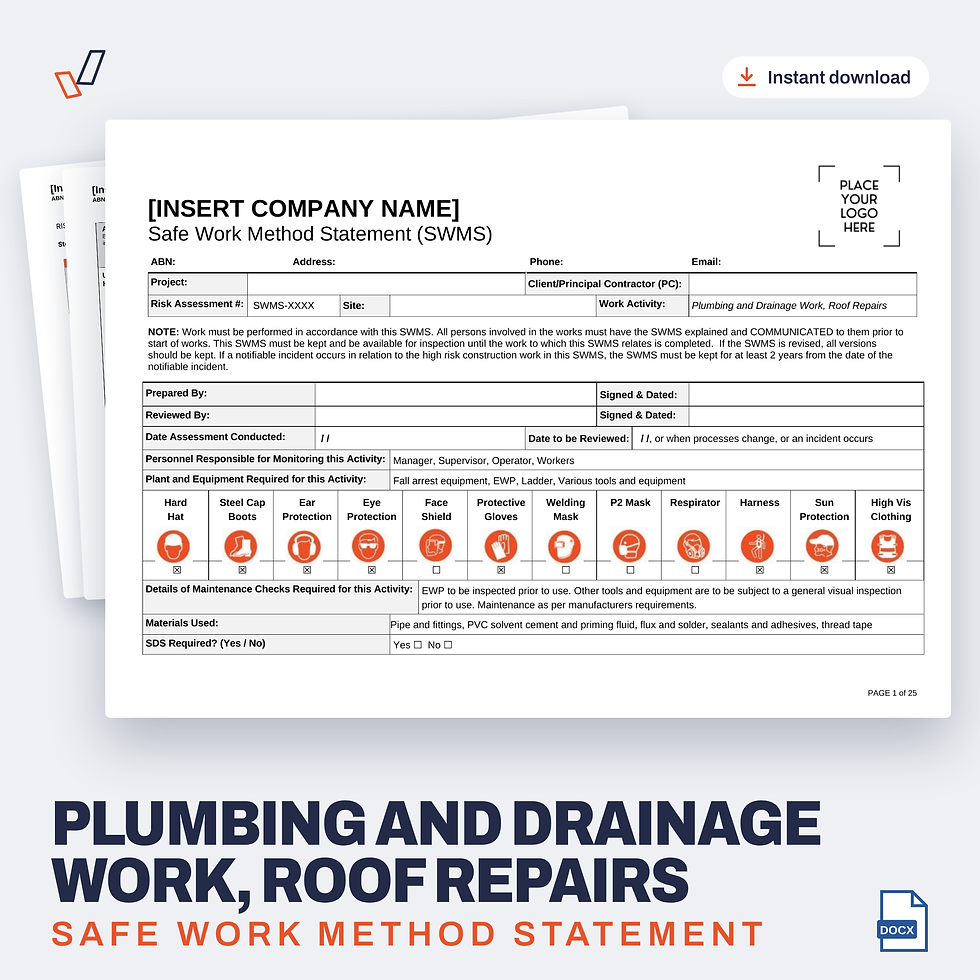
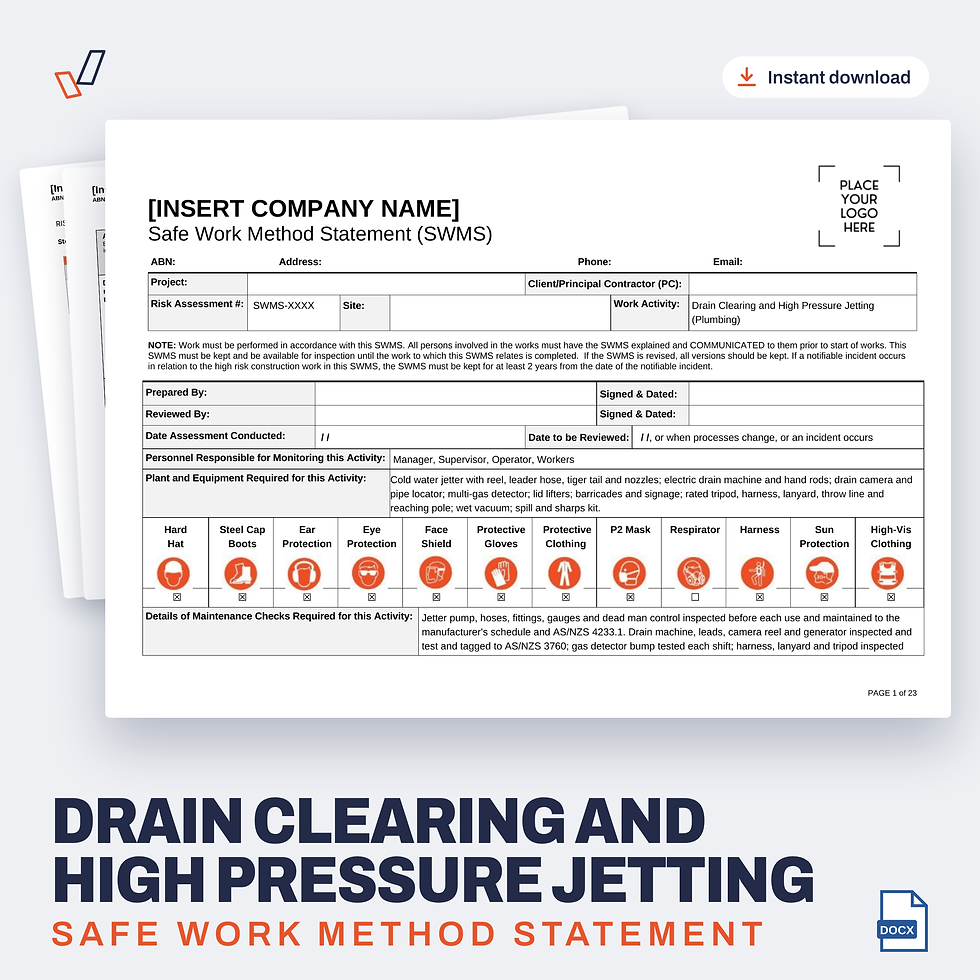
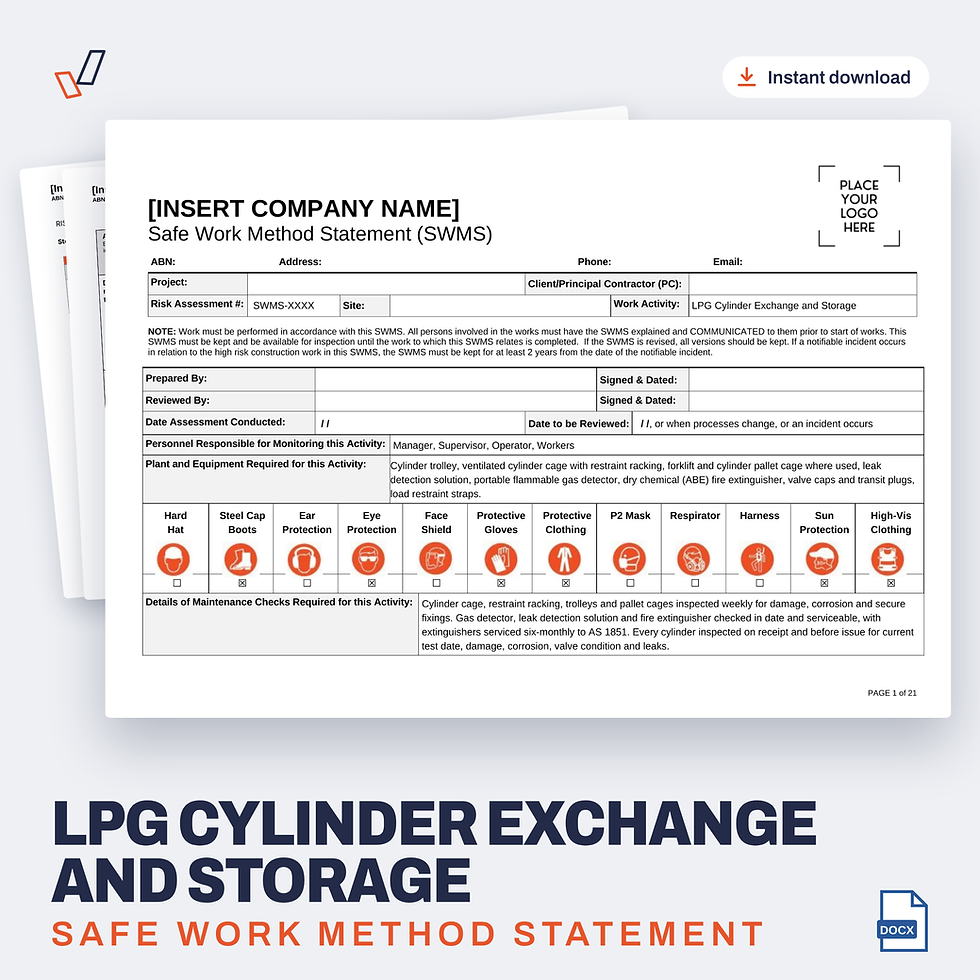
This Backflow Prevention Testing SWMS (Safe Work Method Statement) is pre-filled and covers testing, servicing and replacing testable backflow devices in pits, plant rooms, fire services and on roofs. It sets out the hazards, control measures and risk ratings before and after controls for 38 activities, from confirming licensing and water shutdown approval to restoring the fire service and emergency response. It's written by WHS specialists, aligned to Australian WHS legislation, and fully editable in Microsoft Word.
Who it's for
Licensed plumbers with a backflow prevention endorsement
Backflow testing and certification businesses
Fire protection contractors servicing hydrant and sprinkler services
Facilities and building maintenance contractors
Council and water utility maintenance crews
A SWMS isn't just for building sites. Many plumbing and fire service businesses use one as the written risk assessment for a task, much like a JSA or Safe Work Procedure.
Use it to
Show clients, insurers and auditors how you manage the risks
Apply for tenders, contracts and supplier panels
Get through prequalification with Avetta, Cm3 and other contractor portals
Induct new workers and train them in the task
What this SWMS covers
Licensing, device schedules, water shutdown approval and occupant notification
Fire service impairment approval, and restoring the fire service after testing
Opening heavy pit lids and stopping people falling into open pits
Pit atmosphere assessment and confined space entry with a standby person, retrieval and rescue
Contaminated water, vermin, Legionella aerosols, and snakes and spiders in pits and enclosures
Roof and elevated pipework access, EWP use, suspension rescue and dropped tools
Plant rooms, fire pumps starting automatically, and energised electrical equipment near water
Isolating and depressurising the service, and connecting the test kit to the test cocks
Recycled, non-potable and chemically dosed systems, and asbestos cement pipe and lagging
Servicing device internals with stored spring energy, and manual handling of large valves
Pipework alterations with cutting, brazing and silica dust, plus sealants and chlorine disinfection
Discharge of test and flush water, recommissioning, and emergency response to collapse, shock, scald or splash
What's included
Hazards and control measures for 38 work activities
Risk ratings before and after controls, with a 5x5 risk matrix and the hierarchy of controls
PPE requirements checklist and high risk construction work checklist
Plant and equipment list, materials, and maintenance checks for test kit calibration and gas detectors
Relevant Australian Standards, including AS/NZS 2845.3 for field testing and AS/NZS 2865 for confined spaces
Qualification notes covering the backflow endorsement, confined space entry and standby, and EWP licensing
Site specific hazards section for anything unique to your job
Worker sign-off sheet and worker consultation record
Why use this template
Saves hours compared with writing a SWMS from a blank page
Covers the most common hazards and control measures for this work, ready to use out of the box
Fully editable, so you can add, remove or change anything to suit your site and how your team works
Helps your business stay compliant, with risk ratings, worker sign-off and consultation records already set up
How it works
Buy online and download straight away. You'll also get an email with your link.
Add your logo, ABN, project and site details.
Check it suits your site and task, edit anything you need to, and consult your workers before you finalise it.
Brief your team and collect signatures.
Common questions
Do I need a SWMS for backflow prevention testing?
Only if the job is high risk construction work, for example entering a pit or valve chamber that is a confined space, accessing a device where someone could fall more than 2 metres, or working near energised electrical equipment in a plant room. Otherwise a SWMS isn't mandatory, but you still have to manage the risks, and a SWMS is a sound way to record how. Clients, building managers and prequalification portals often ask for one.
Does it cover fire service impairments?
Yes. It covers getting approval before a hydrant or sprinkler service is isolated, the risk of a fire pump starting automatically during testing, and restoring the fire service and closing the impairment when the work finishes.
Can I change it?
Yes. It's a Microsoft Word file, so you can add, remove or change any hazard, control or rating, and add your own logo and details.
Does it suit my state?
Yes. It's written to the model WHS laws and suits all states and territories, including Victoria under the OHS Act and Regulations.
What if it doesn't suit my work?
You're covered by our 30-day money-back guarantee if it isn't fit for purpose.