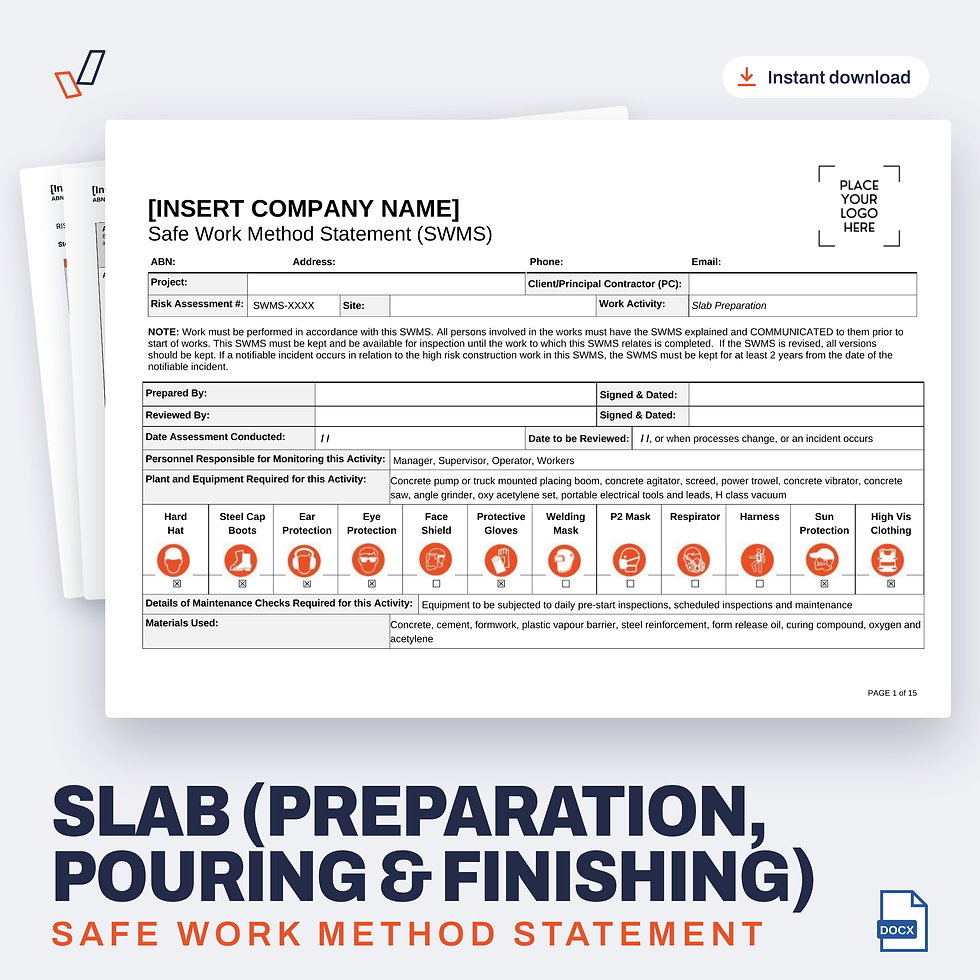
This Fire Extinguisher Service and Maintenance SWMS (Safe Work Method Statement) is pre-filled and covers servicing, discharging, pressure testing and recharging portable fire extinguishers, plus hose reels and fire blankets, on customer sites and in the workshop. It covers 26 activities, from the daily pre-start to housekeeping and end of shift, with the hazards, control measures and risk ratings before and after controls for each. It's written by WHS specialists, aligned to Australian WHS legislation, and fully editable in Microsoft Word.
Who it's for
Fire equipment service companies and extinguisher technicians
Fire protection contractors with a service workshop
Mobile technicians servicing commercial and industrial sites
Facilities teams that service their own portable fire equipment
A SWMS isn't only for construction. Plenty of fire equipment businesses use one as the written risk assessment for a task, the same way others use a JSA or Safe Work Procedure.
Use it to
Show clients, insurers and auditors how you manage the risks
Apply for tenders, contracts and supplier panels
Get through prequalification with Avetta, Cm3 and other contractor portals
Induct new workers and train them in the task
What this SWMS covers
Pre-start planning, cylinder deliveries and inspecting the test rig and access equipment
Restraining cylinders in the service vehicle and driving between sites
Site induction, forklifts and vehicles, and avoiding unwanted brigade calls
Reaching extinguishers in plant rooms, cabinets, cool rooms and freezers
Replacing brackets with cable detection and silica dust controls
Manual handling of cylinders and identifying a suspect cylinder
Depressurising and discharging units, dry chemical powder and carbon dioxide asphyxiation
Hydrostatic pressure testing, recharging and preventing over-pressurisation
Foam and wet chemical agents, hose reels and fire blankets
Bench work, noise, and cylinder storage, segregation and quarantine
Interim cover when units leave service, working alone and customer aggression
Emergency response to cylinder failure, asphyxiation, cold burn or chemical exposure
What's included
Hazards and control measures for 26 work activities
Risk ratings before and after controls, with a 5x5 risk matrix and the hierarchy of controls
PPE requirements checklist and high risk construction work checklist
Plant and equipment list, including the pressure test rig, charging plant and oxygen depletion alarm
Relevant Australian Standards, including AS 1851 for routine service and AS 2030.5 for cylinder filling and testing
Who can service, test and recharge each class of extinguisher, and the training each worker needs
Site specific hazards section for anything unique to your job
Worker sign-off sheet and worker consultation record
Why use this template
Saves hours compared with writing a SWMS from a blank page
Covers the most common hazards and control measures for this work, ready to use out of the box
Fully editable, so you can add, remove or change anything to suit your site and how your team works
Helps your business stay compliant, with risk ratings, worker sign-off and consultation records already set up
How it works
Buy online and download straight away. You'll also get an email with your link.
Add your logo, ABN, project and site details.
Check it suits your site and task, edit anything you need to, and consult your workers before you finalise it.
Brief your team and collect signatures.
Common questions
Do I need a SWMS for fire extinguisher servicing?
Usually no. Servicing extinguishers isn't high risk construction work, so a SWMS only becomes a legal requirement if the job crosses into it, for example drilling for a new bracket near energised electrical installations on a building site. You still have to manage risks like cylinder rupture and carbon dioxide asphyxiation, and a SWMS is a practical way to record how. Clients, insurers and prequalification portals often ask for one.
Does it cover hydrostatic pressure testing?
Yes. It covers test rig operation, test bay set-up, catastrophic cylinder failure and high pressure water injection. It also notes that cylinder periodic testing and restamping is done only by an approved gas cylinder test station.
Can I change it?
Yes. It's a Microsoft Word file, so you can add, remove or change any hazard, control or rating, and add your own logo and details.
Does it suit my state?
Yes. It's written to the model WHS laws and suits all states and territories, including Victoria under the OHS Act and Regulations.
What if it doesn't suit my work?
You're covered by our 30-day money-back guarantee if it isn't fit for purpose.